
Subcritical or Transcritical CO₂: Which Refrigeration System to Choose
CO₂ (R744) can run in subcritical or transcritical systems. We explain how they differ, when each one makes sense and what to weigh up before deciding.
Ingeniería Isofred
Departamento Técnico - Isofred
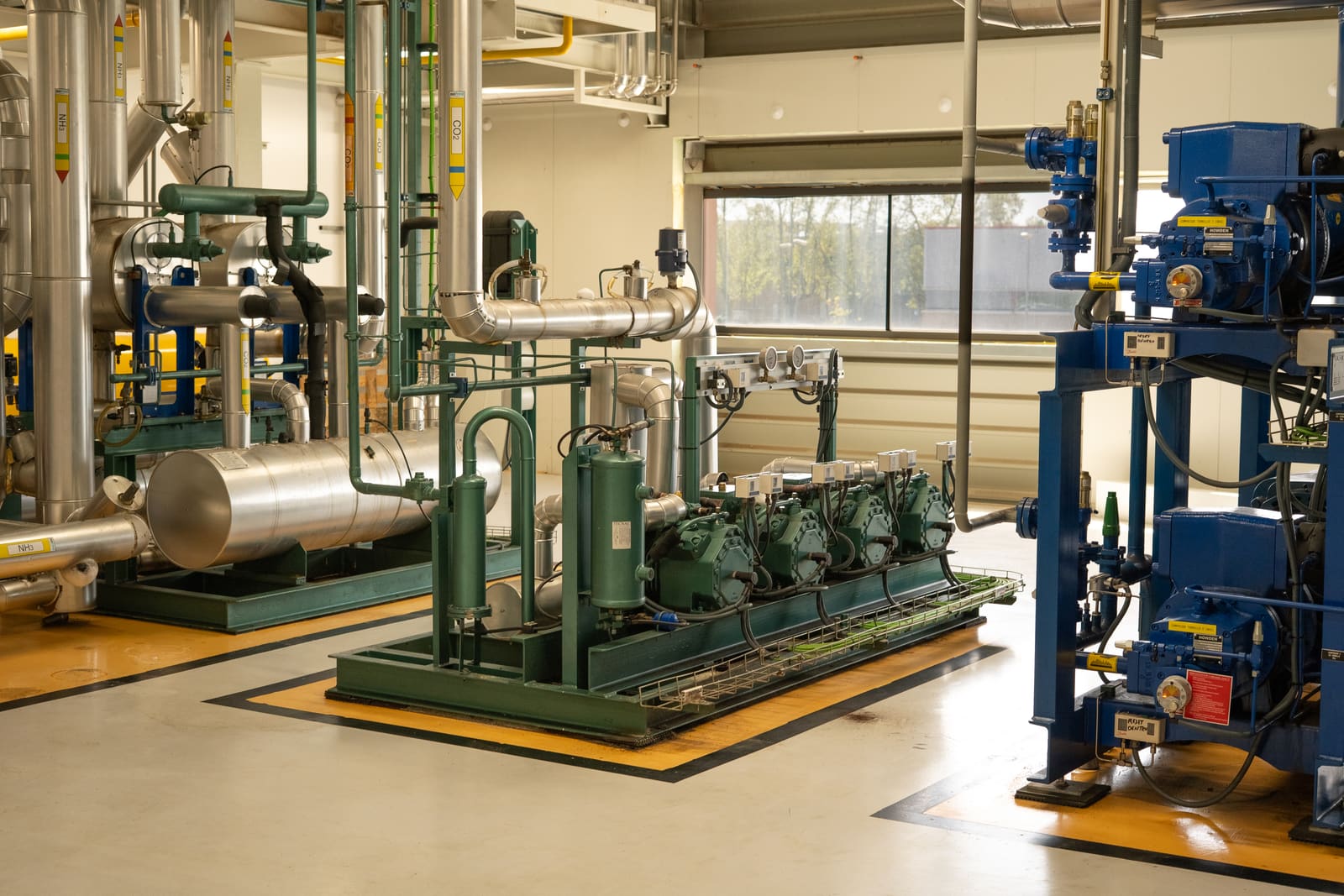
CO₂, known as R744 when used as a refrigerant, can run in subcritical or transcritical systems. The difference is how heat is rejected: in a subcritical system CO₂ condenses below its critical point; in a transcritical one the high side goes above that point and heat is rejected in a gas cooler, without conventional condensation.
Neither is better in absolute terms. The choice depends on the process, temperatures, climate, capacity, heat recovery and the maintenance available.
Quick answer
Subcritical CO₂ is mainly used for low temperatures, in cascade with another refrigerant (often ammonia). Transcritical CO₂ can cover medium and low temperatures with CO₂ alone, but it runs at higher pressures and needs more specialised design and control, especially in hot climates.
31 °C · 73.8 bar
Approximate critical point of CO₂
A1 · GWP 1
Non-flammable, minimal climate impact
140–150 bar
Design pressure of some transcritical components
What is R744 and why is it used in industrial refrigeration?
It is carbon dioxide used as a refrigerant: natural, fluorine-free, with zero ozone depletion potential and a reference GWP of 1. It is safety class A1 (low toxicity, non-flammable), has high volumetric cooling capacity that allows smaller pipework, performs well at low temperatures and can produce cooling and heat from the same system.
In exchange, it runs at much higher pressures than HFCs and needs dedicated components. And although it is A1, at high concentrations it displaces oxygen. It should not be chosen just because it is natural: the right configuration depends on each installation.
What is the critical point and why does it change the design?
Below about 31 °C and 73.8 bar, CO₂ condenses from gas to liquid like any refrigerant. Above that, the distinction between liquid and vapour disappears and the fluid becomes supercritical. That means the condenser is replaced by a gas cooler and the high-side pressure has to be actively controlled to optimise capacity and efficiency. This is why outdoor temperature matters so much in a system that rejects heat to ambient air.
An important nuance
A “transcritical” system does not run above the critical point all year: it is designed to be able to cross it. In moderate weather it spends many hours operating subcritically.
How does subcritical CO₂ work in a cascade?
In a subcritical installation the whole cycle stays below the critical point. Condensing CO₂ below about 31 °C needs a cold medium, so the usual solution is a cascade: CO₂ provides low-temperature cooling and a second circuit (ammonia, an A2L, a hydrocarbon or cold glycol) takes its heat in an exchanger that acts as the CO₂ condenser and the upper circuit's evaporator. CO₂ never condenses against outdoor air, so it stays subcritical even in hot weather.
It is very common in freezer rooms and tunnels, frozen storage and NH₃/CO₂ cascades in food processing. Design pressures are lower than transcritical, and it allows ammonia to be kept out of work areas, confined to the machinery room. The trade-off is two technologies with coordinated controls, and if the upper circuit stops, CO₂ pressure rises: even at standstill, trapped CO₂ absorbs heat from its surroundings.
How does transcritical CO₂ work?
The compressor discharges above the critical point and the refrigerant cools in the gas cooler without changing phase. A high-pressure valve then expands it into an intermediate receiver: the liquid feeds the evaporators and the flash gas is handled by bypass, parallel compression or ejectors. Good control of gas cooler and receiver pressure is key to efficiency and stability.
The most widespread configuration is the booster: a single plant serves medium and low temperatures, with low-stage compressors discharging into the medium-stage suction, all on CO₂ with no second refrigerant. It started in supermarkets and is now used in logistics centres, fresh and frozen distribution platforms and food processing, especially where cooling, freezing and heat recovery can all be exploited together.
Subcritical vs transcritical CO₂: main differences
| Criterion | Subcritical CO₂ | Transcritical CO₂ |
|---|---|---|
| Heat rejection | Condensation (in cascade) | Gas cooler |
| High-side pressure | Lower | Higher |
| Second refrigerant | Usually needed | Can run on CO₂ alone |
| Typical use | Low temperature and freezing | Medium and low temperature |
| Climate dependence | Lower in the CO₂ circuit | Higher if rejecting heat to air |
| Complexity | Two coordinated circuits | Advanced high-pressure control |
| Heat recovery | Possible | Particularly attractive |
What pressures does it run at, and what happens during a shutdown?
Some transcritical components are designed for 140–150 bar, while subcritical ones work to lower limits. Equipment, pipework, valves, welds and tests must all match the circuit's design pressure, including the pressure reached at standstill: a fitting having the right diameter is not enough.
What happens during a shutdown
If the system stops, the CO₂ picks up heat from its surroundings and its pressure rises quickly. The design has to plan for this: receivers sized for standstill, sufficient design pressure, a small auxiliary unit or emergency power. Venting through the relief valve protects the equipment, but it should not be the normal way of handling shutdowns.
Which system uses less energy?
There is no universal winner. Consumption depends on outdoor temperature, evaporating temperatures, gas cooler outlet temperature, part loads, the annual profile, heat recovery and controls. In cool months a transcritical system runs close to or below the critical point and performs very well; in summer, without the right strategy, efficiency drops. Parallel compression, ejectors, adiabatic cooling, subcooling and floating pressure recover much of that penalty.
In climates like Lleida or Zaragoza, with very hot summers, transcritical works, but it must be designed for that climate (gas cooler position, real hot hours, adiabatic cooling, ejectors) rather than copying a layout optimised for northern Europe. Danfoss has published a simulation study using real climate data that illustrates this: the comparison always has to be made for each project's climate, capacity and operating profile, using an annual energy simulation rather than a single rated point.
Can heat be recovered from a CO₂ system?
Yes, and it is one of its strongest points. A transcritical system discharges at high temperature, which can produce domestic or cleaning hot water, space heating, process water preheating or defrost heat. Its real value depends on heating demand coinciding with cooling demand, the temperature needed, the distance to the point of use and storage. A plant that uses hot water every day gets far more out of it than one with occasional demand.
Is CO₂ safe?
It is A1 and non-flammable, but not risk-free: it is colourless, gives no reliable warning smell, is heavier than air and collects in low areas, where it can cause asphyxiation. Add high pressures, cold burns during discharges and trapped-liquid expansion. That is why it needs CO₂ detectors at the right height, alarms, emergency ventilation, discharges routed to a safe place, properly sized relief valves and trained staff. As it is not a fluorinated gas, the EU F-gas HFC phase-down does not apply to it, but Spain's RSIF (Royal Decree 552/2019), pressure equipment rules and occupational safety rules do.
When to choose subcritical, transcritical or something else?
Subcritical CO₂
When the main demand is freezing, there is (or will be) an ammonia plant and you want NH₃ out of work areas, a lower design pressure is preferred and staff are ready to operate a cascade.
Transcritical CO₂
When medium and low temperatures are needed with a single refrigerant, there is steady hot-water demand to make use of heat recovery, the plant runs many hours and specialised maintenance is close by. A common case in multi-temperature logistics centres.
Another option
With very high industrial capacities, a single operating temperature, teams highly experienced with ammonia or no local CO₂ service, ammonia, an indirect system or an NH₃/CO₂ cascade usually fit better.
The study should compare complete solutions, not refrigerants in isolation, based on total cost over the system's life: investment, energy, maintenance, heat recovery and the risk of downtime.
Isofred CO₂ projects
La Piemontesa (Lleida)
5,000 m² central kitchen and logistics centre for a pizzeria chain: an ammonia plant for chilled storage and air conditioning, integrated with CO₂ for freezing and heat recovery, all managed by its own SCADA system to optimise energy use.
Copima (Graus, Huesca)
Food-service logistics centre with over 6,000 m² of facilities: an ammonia plant with 35 % propylene glycol for chilled storage and air conditioning, and a separate CO₂ system for freezing.
Both follow the same logic: ammonia confined to the machinery room for positive temperatures and CO₂ for freezing. See these and other cases in our projects and on our refrigeration for logistics page.
Which mistakes come up most often with CO₂?
- Choosing it only because it is natural, or confusing low toxicity with no risk.
- Not studying what happens to pressure during a shutdown or power cut.
- Sizing for a single outdoor temperature and ignoring the local climate.
- Installing components without enough design pressure.
- Not calculating annual consumption or how much heat can really be used.
- Copying a supermarket configuration into an industry with a different load profile.
- Comparing only the upfront price.
Considering a CO₂ refrigeration system?
Tell us about your process, temperatures and capacity, and we will prepare a comparative study of the viable options for your plant.
Frequently asked questions
What is the difference between subcritical and transcritical CO₂? In a subcritical system CO₂ condenses below its critical point, usually in cascade with another refrigerant. In a transcritical system the discharge goes above that point and heat is rejected in a gas cooler, without conventional condensation.
Which uses less energy? It depends on climate, temperatures, configuration and heat recovery. Consumption has to be simulated for the installation's real annual profile.
Is CO₂ flammable? No. It is A1. But it displaces oxygen, collects in low areas and can cause asphyxiation at high concentrations.
Does the F-gas Regulation apply to it? Not in the way it applies to HFCs, because it is not a fluorinated gas. The installation must still comply with the RSIF, pressure equipment rules and other safety regulations.
Does transcritical work in hot climates? Yes, with the right design: parallel compression, ejectors, subcooling or adiabatic cooling greatly improve its summer performance.
Technical note: the optimal configuration depends on the process, temperatures, capacity, climate, operating hours and maintenance capability. This article is for information only and does not replace a refrigeration calculation or an RSIF-compliant design.