

RSIF explained: what Royal Decree 552/2019 requires of a refrigeration installation
The RSIF requires every refrigeration installation in Spain to be classified, documented according to its level, built by an authorised refrigeration company and registered with the regional authority before start-up. This guide explains it step by step.
Ingeniería Isofred
Departamento Técnico - Isofred
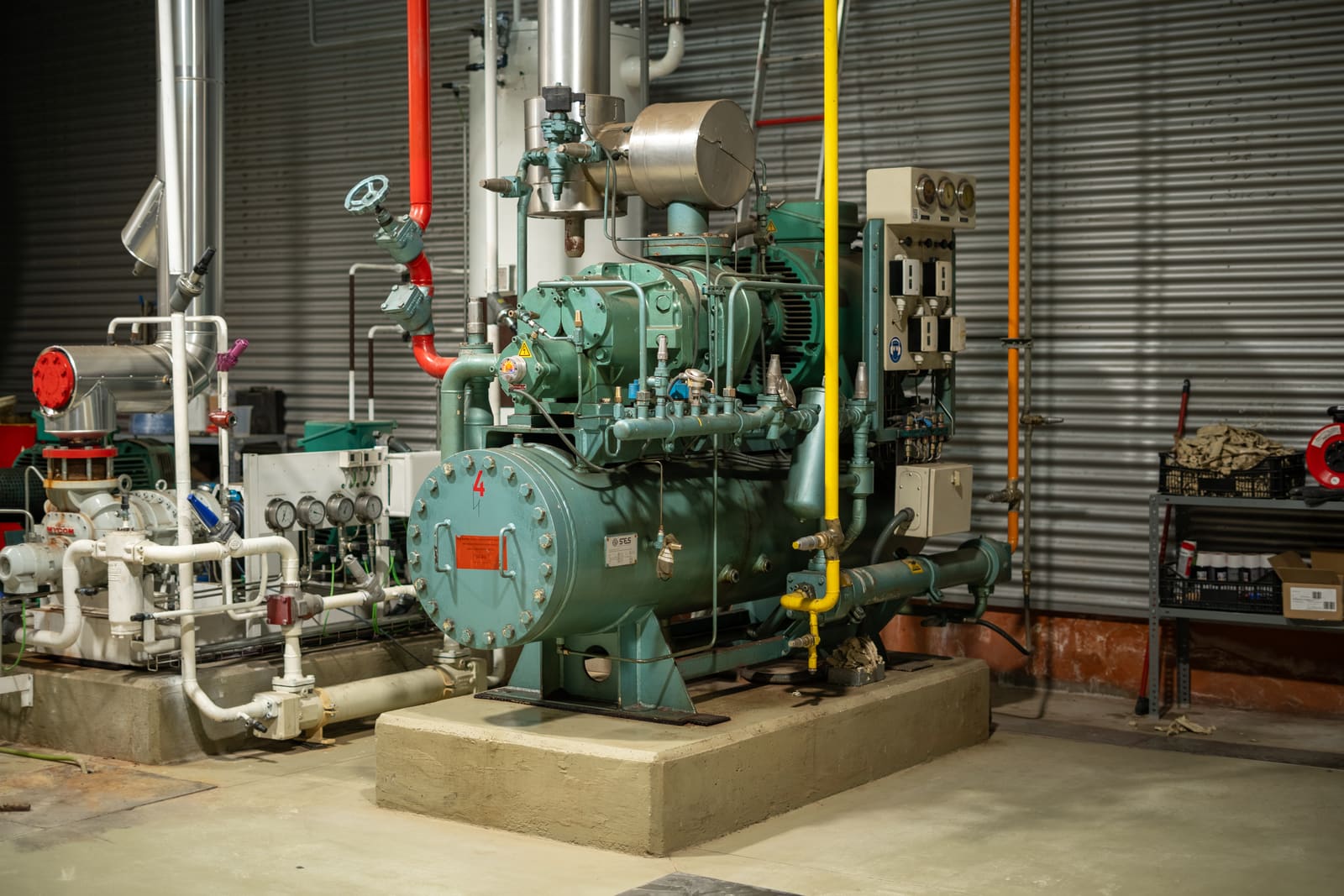
The RSIF (Spain's Safety Regulation for Refrigeration Installations), approved by Royal Decree 552/2019 and in force since 2 January 2020, requires every refrigeration installation to be classified as level 1 or level 2, designed and built with the technical documentation that matches its level, installed by an authorised refrigeration company and registered with the regional authority before it is put into service.
After that, the owner has to keep it compliant: an up-to-date logbook, a maintenance contract where required, periodic checks, leak checks and inspections. This guide explains each step and how to tell whether your installation complies.
Quick answer
Before putting a refrigeration installation into service you must: 1) classify it as level 1 or level 2; 2) prepare the technical report or the design project; 3) have it built and certified by an authorised refrigeration company; 4) register it with the competent regional authority. Once running, the owner must keep the documentation and meet periodic checks, leak checks and inspections.
RD 552/2019
Royal Decree that approves the RSIF
2 levels
Level 1 and level 2, by potential risk
5 years
General periodic check (IF-14)
What is the RSIF and who does it apply to?
The RSIF is the Spanish regulation that sets the safety conditions for refrigeration installations in order to protect people, property and the environment. The main text is complemented by technical instructions (IF) covering refrigerant classification, machinery rooms, documentation, testing, maintenance, leak checks and protective equipment.
It applies to:
- New refrigeration installations.
- Extensions of existing installations.
- Modifications and relevant changes.
- Maintenance, repair and decommissioning.
- Existing installations, in the aspects that concern them.
There are exclusions and special regimes for some packaged units, low-charge systems, absorption installations, means of transport and certain installations covered by the RITE (Spain's building thermal installations regulation). That is why the scope is checked case by case before starting the paperwork.
Is my installation level 1 or level 2?
This is the first step, because the level decides which documentation, which engineer and which type of refrigeration company are needed. Article 8 of the RSIF sets two levels based on potential risk:
| Criterion | Level 1 | Level 2 |
|---|---|---|
| Power per system | Up to 30 kW | Over 30 kW in any system |
| Total power | Up to 100 kW | Over 100 kW |
| Refrigerants | High safety (L1) | Medium or low safety (L2 and L3) |
| Artificial atmosphere | Does not cool these rooms | Includes artificial-atmosphere rooms |
| Technical document | Technical report | Design project |
| Site supervision | Not always required | Qualified competent engineer |
| Refrigeration company | Level 1 or higher | Level 2 |
Meeting just one of the level 2 conditions is enough for the installation to become level 2. And power is not the only criterion: the refrigerant and the use of the rooms weigh just as much.
Indicative example
Two independent 25 kW systems (50 kW in total), with L1 refrigerant and no artificial-atmosphere rooms, could be level 1. If one of those systems were 40 kW, the installation would normally become level 2 even though the total stays below 100 kW. A small installation using an L2 or L3 refrigerant, or serving a controlled-atmosphere room, would also be level 2.
The final classification requires reviewing the full configuration: shared circuits, refrigerant, charges and the use of the refrigerated spaces.
What design requirements does the RSIF set?
Article 20 requires installations, materials and equipment to comply with the regulation itself and with all other applicable rules: machinery, pressure equipment, leak prevention and, where relevant, Legionella prevention. The design must address, among other things:
- Refrigerant classification and charge.
- Electrical power installed in the compressors.
- Access category of the premises, dimensions and ventilation.
- Overpressure protection and safe venting of discharges.
- Detectors and alarms where required, and personal protective equipment.
- Machinery room conditions (instruction IF-07).
- Identification of piping and equipment, and material resistance to operating temperatures and substances.
Equipment and components must also carry the required marking, declarations of conformity and certificates. If the installation uses ammonia or flammable refrigerants, the maximum allowable charge in the machinery room deserves its own analysis.
Technical report or design project? Who signs it?
Level 1: technical report
A descriptive technical report, signed by a refrigeration installer or a qualified competent engineer, describing the solution and showing that it complies with the regulation.
Level 2: design project
A project drawn up and signed by a qualified competent engineer, built under their supervision and closed with a final site-supervision certificate. It must include the TEWI calculation (total equivalent warming impact).
The special case of A2L
Some installations that are level 2 because they use A2L refrigerants can be processed with a technical report if they stay within the regulation's power, charge, use and safety limits. If they exceed them, a risk assessment and a level 2 refrigeration company may be required. Do not assume every A2L installation qualifies for a technical report.
Who can build the installation?
An authorised refrigeration company holding the level the work requires. For installations within the scope of the RITE, installers authorised under that regulation may also take part, within the limits of their authorisation. At level 2, the work is supervised by a qualified competent engineer. During the works the following are checked:
- Receipt and conformity of materials and equipment, with their CE marking and declarations.
- Execution in line with the technical report or project.
- Correct installation of safety devices.
- Strength and tightness of the system.
- Operation of controls, alarms and protections.
- Match between what was designed and what was actually built.
Isofred is a Category I refrigeration company under RD 552/2019, with a qualified engineer and certified refrigeration installers on staff, so it can take on installations of any level without subcontracting the critical technical work.
What documentation is needed to register it?
Once the installation is finished and tested, the owner submits the documentation to the competent authority of their region. Each region has its own forms and online procedures, so besides the RSIF you need to check the local procedure. As a general rule:
| Document | Level 1 | Level 2 |
|---|---|---|
| Technical report of the as-built installation | ✓ | — |
| Design project of the as-built installation | — | ✓ |
| Site-supervision certificate | — | ✓ |
| Installation certificate (refrigeration company or RITE installer) | ✓ | ✓ (also signed by the supervising engineer) |
| Electrical installation certificate or equivalent | Where applicable | ✓ |
| Declarations of conformity for pressure equipment, piping and accessories | ✓ | ✓ |
| CE declaration of conformity for the assembly or equipment | Where applicable | ✓ |
| Civil liability insurance policy | — | Where mandatory |
| Maintenance contract | — | ✓ (unless self-maintaining company) |
What obligations does the owner have afterwards?
Compliance does not end at commissioning. Article 18 makes the owner responsible for keeping the installation within its operating limits and in safe condition:
- Not starting it up before the documentation and registration are complete.
- Contracting maintenance and statutory checks, unless it is a self-maintaining company.
- Keeping the documentation, logbook, safety sign and operating manual up to date.
- Appointing a properly trained person in charge of the installation.
- Ensuring the necessary protective equipment is used.
- Requesting periodic inspections and reporting accidents as the regulation requires.
- Shutting the installation down if it no longer offers the necessary safety guarantees.
Civil liability insurance
For level 2 installations with L2 or L3 refrigerants, the owner must generally hold civil liability insurance with minimum cover of €500,000. There is a conditional exemption for certain A2L installations that stay within the charge limits and require no additional protective measures.
What must the logbook contain?
The logbook, on paper or digital, is the technical and regulatory history of the installation. Among other data it records the make and model of the equipment and where it came from, the refrigeration company that built it, the dates of inspections and checks (mandatory and voluntary), repairs and modifications, and which company carried out each intervention and when it was completed.
It should not be filled in only before an inspection: its purpose is to prove, day by day, that the statutory work has been done.
How often must a refrigeration installation be checked and inspected?
Three things should not be confused: maintenance (preventive and corrective), the periodic check carried out by the refrigeration company, and the inspection carried out by an accredited inspection body.
Under IF-14, refrigeration systems must undergo a mandatory periodic check at least every five years. Systems with more than 3,000 kg of refrigerant and over fifteen years old, at least every two years. The check covers corrosion, piping and insulation, pressure limiters and safety valves, vessels, leak detectors, nameplates, protective equipment, cooling towers and evaporative condensers, and pressure equipment. Afterwards the company issues the certificate and records it in the logbook.
| Situation | Inspection |
|---|---|
| Level 2 installation | Every 10 years |
| Fluorinated refrigerant: 50 to under 500 t CO₂ eq. | Every 5 years |
| Fluorinated refrigerant: 500 to under 5,000 t CO₂ eq. | Every 2 years |
| Fluorinated refrigerant: 5,000 t CO₂ eq. or more | Every year |
| Pressure equipment included in the IF-14 inspection | Every 10 years |
The applicable interval is calculated from each installation's actual data and the legislation in force on the date of the check. If you want to outsource it, our maintenance and service team manages the calendar of checks, leak checks and inspections.
What are the most common mistakes?
Non-compliance does not always come from a visible technical fault. Very often it is a documentation problem:
- Classifying the installation by power alone, ignoring the refrigerant's safety group.
- Treating as independent several systems that are actually connected.
- Carrying out a modification or extension without updating the technical report or project, or without registering it.
- Changing refrigerant without analysing how it affects the level and safety.
- Not having the mandatory maintenance contract.
- An incomplete logbook, or certificates for equipment, piping and interventions that are not kept.
- Confusing maintenance, periodic checks and inspections.
- Safety sign and operating manual not updated.
Before any change
Replacing equipment, increasing power or switching refrigerant can change the classification and the safety conditions. Review the technical and administrative consequences before doing it, not after.
How can I tell if my installation complies with the RSIF?
A first self-check:
- Is it registered with the competent authority?
- Is it correctly classified as level 1 or level 2?
- Does it have an up-to-date technical report or project that matches what is actually installed?
- Do you keep the electrical, refrigeration and pressure equipment certificates?
- Is the logbook up to date?
- Is there a maintenance contract where one is mandatory?
- Are checks, inspections and leak checks within their deadlines?
- Is there a trained person in charge, and are the safety sign and manual up to date?
- Were later modifications documented and registered?
A “no” to any of these questions does not by itself tell you how serious the non-compliance is, but it does justify a technical and documentation review.
How Isofred helps
We review the technical side and the paperwork together to find the gaps between what is installed, what is documented and what the regulation requires:
Assessment
Classification of the installation, review of power, refrigerant and charge, inventory of equipment and circuits.
Documentation
Checking and updating the technical report or project, reviewing the logbook, outstanding certificates and support with registration.
Execution and follow-up
Modifications and corrective measures, plus coordination of maintenance, periodic checks and inspections.
Not sure whether your installation complies with the RSIF?
An Isofred engineer reviews your installation and its documentation and tells you what is missing, what is surplus and where to start.
RSIF frequently asked questions
What does RSIF stand for? Reglamento de Seguridad para Instalaciones Frigoríficas, Spain's Safety Regulation for Refrigeration Installations. The current version was approved by Royal Decree 552/2019 together with its complementary technical instructions.
Do all installations need a design project? No. Level 1 installations generally need a technical report; level 2 installations need a project signed by a qualified competent engineer. There are exceptions for some installations using A2L refrigerants.
Who can register a refrigeration installation? It is built and certified by companies and professionals authorised for its level. The owner submits the documentation to the competent regional authority, following the local procedure.
How often is a refrigeration installation checked? As a general rule, at least every five years. Some require more frequent checks or inspections because of their charge, age, level or use of fluorinated refrigerants.
Does a level 2 installation need a maintenance contract? Yes, generally with a refrigeration company of the corresponding level, unless the owner is a self-maintaining company. Special conditions apply to certain A2L installations.
What happens if I change the refrigerant? It must be studied beforehand, because it can affect the classification, maximum charge, material compatibility, ventilation, detection, flammability risk and documentation. It is not a simple fluid swap.
Note: this content is for information only and does not replace the study of a specific installation. It was prepared from the consolidated text of Royal Decree 552/2019 published in the BOE (Spain's Official State Gazette); for legal purposes, refer to the official publications.